Buying screws in bulk for a contracting business means buying by the case from a fastener supplier who quotes you a price and delivers right to your door, instead of picking up boxes at the hardware store as you need them. Getting it right comes down to knowing exactly which screw you use and how many you go through. Once you know those two things, a supplier can tell you how many screws come in a case, how much you need to buy before the price per screw drops and what shipping adds to the order.
All Points Fasteners has been serving contractors since 1986. These nine steps are the ones we walk contractors through on the phone when they’re getting ready to buy by the case.
Why buy by the case instead of by the box?
Buying by the case saves a contracting business money, time and trouble, as long as you buy what you’ll actually use.
- A lower cost per screw. Suppliers lower the price per screw at set quantities, called price breaks. Once your order reaches one, each screw costs less than it would in a smaller order.
- Less time spent looking for stock. With a case on the shelf, the crew has the screw when they need it. Nobody spends time hunting for it or leaves the job to go buy more.
- The same screw every time. When you reorder from one supplier by part number, you get the screw your crew knows will work, not whatever the store had in stock that week. Step 8 covers how to make sure of that.
- Protection from price increases. Right now, buying ahead protects you from any possible price increases due to tariffs and shipping costs. The screws on your shelf are already paid for.
How to buy screws in bulk, step by step
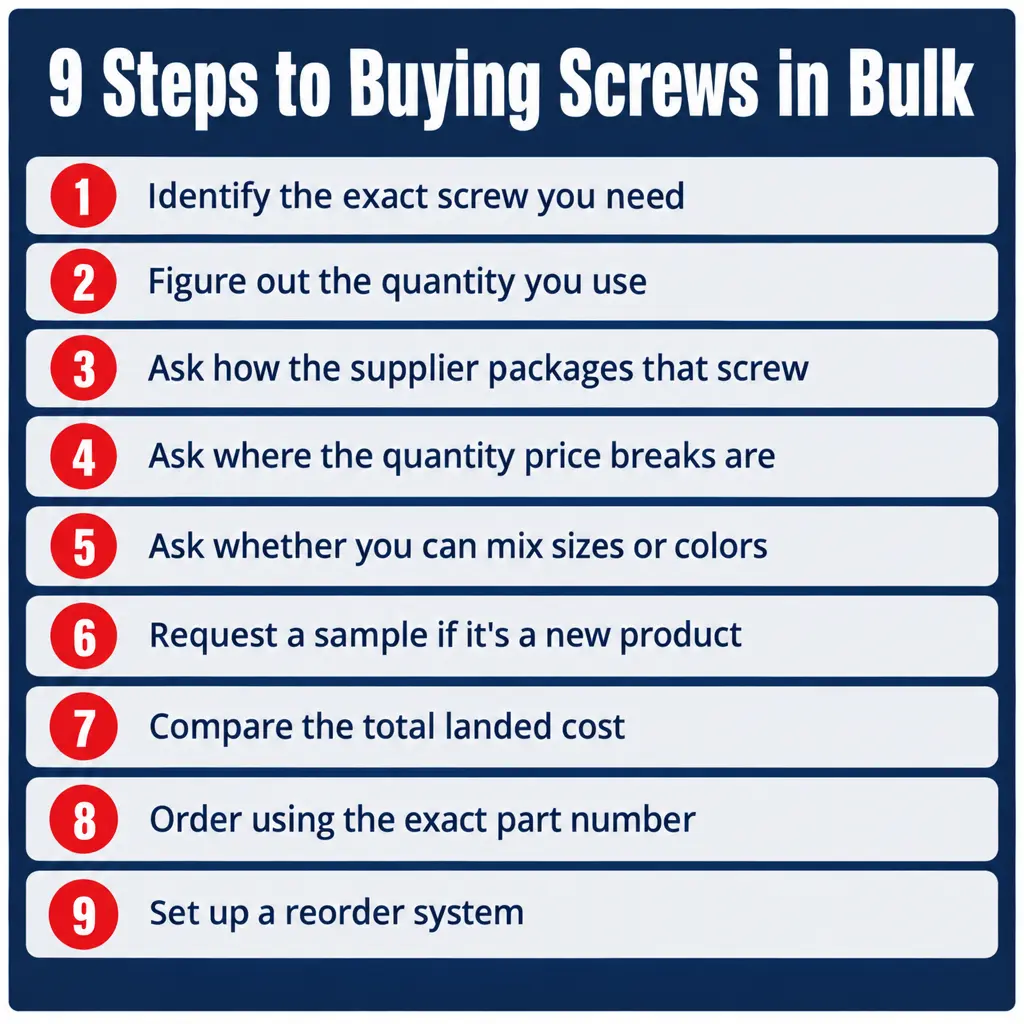
1. Identify the exact screw you need
Know the size, length, head style, point, material, finish and application. “A box of roofing screws” isn’t enough to order by the case, because dozens of screws fit that description and only one of them is the one your crew uses. Take a screw from the box you buy now and write down:
- Size: the diameter, such as #8 or #10
- Length: such as 3/4 inch or 1 inch
- Head style: hex washer head, pan head and so on
- Point: a sharp point or a drill point
- Material: what the screw is made of, such as carbon steel or stainless
- Finish: the coating or color
- Application: what you drive it into, such as ductwork, a metal roof panel, fascia board or roofline trim
If you want to see the options side by side, our screws page lays out the types we carry. For a closer look at self-drilling screws, the ones with a drill point, our tek screw primer video walks through the basics.
If you know the job but not the name of the part, that’s normal. Most people don’t know the head style or point they need by name. Just call us and describe the job, and one of our specialists will help you figure it out. Figuring out the part is our job.
2. Figure out the quantity you use
Estimate how many you use per job, per week or per month. The easiest way is to look back at what you’ve bought over the last few months: count the boxes, multiply by the count per box and divide by the number of weeks. If your work is seasonal, use your busy months, because that’s when running out hurts.
Your weekly or monthly use is the quantity a supplier quotes on, since the price per screw depends on how many you buy. It also helps you decide how often to order. Some customers buy every quarter, others every six months and some once a year. Once the screws are on the shelf, it’s one less thing on your plate, and screws don’t go bad.
3. Ask how the supplier packages that screw
Find out how many are in a case. The smaller the screw, the more screws to a case. Most companies try to pack about 45 pounds in one case, and a pound of small screws holds more pieces than a pound of big ones. Packing to a set weight makes it easy for them to figure out freight breaks, the weights where the shipping rate changes, which are based on total weight shipped.
Check the case count against your number from step 2, because it tells you whether one case lasts you a month or a year. When you compare quotes, compare the price per screw or per thousand, not the price per case, because two suppliers can pack the same screw in different counts.
4. Ask where the quantity price breaks are
Every supplier sets its price breaks at different quantities, so ask where they are. Does the price change at one box, one case, five cases or a pallet? Ours are at 1, 2, 4, 6, 12, 24 and 48 cases, and 48 cases is a full pallet.
Knowing where the breaks are helps you size the order. Say you were planning on three cases and the next break is at four. Ask how much less each screw would cost at four cases. When you request a quote, tell us the quantity you have in mind and we’ll quote that quantity. If you’re close to the next break, ask us for a price at that quantity too.
5. Ask whether you can mix sizes or colors
Some contractors need several related fasteners rather than one huge quantity of a single screw. A gutter and siding crew might need the same screw in a few colors to match different trim. A permanent lighting crew might need painted screws in several colors to match the trim along different rooflines. An HVAC crew might need two lengths of the same sheet metal screw.
With our company, you can mix any fasteners on the same order to reach a price break, including screws, nuts, bolts and rivets, as long as each one is a full case. Two full cases of one screw and two full cases of another count toward the four-case break, whether they differ in type, color or length. When you buy part of a case instead, your pricing will be higher than when you take the full, unbroken case. You can see what we stock for your trade on our industries page, including gutter and siding fasteners and HVAC fasteners.
6. Request a sample if it’s a new product
Ask for a sample especially if you haven’t used that supplier’s screw before. A sample lets your crew drive the screw into the material they actually work with, using the drivers they actually carry, before you commit to cases of it.
With us, samples go out when you ask for them. Request one when you get your quote, and once you’ve approved the quote, we’ll send free samples of stocked items anywhere in the US so you can test them before you order. Our free samples page covers how that works. If the screw is one we don’t stock, we charge you for the sample. When you place the order, we credit that charge off your invoice.
7. Compare the total landed cost
Include freight or shipping and handling charges, not just the case price. Landed cost is what the screws cost by the time they’re on your shelf: the case price plus whatever it costs to get the cases to you. Divide that total by the number of screws and you have the real cost per screw, which is the number to compare between suppliers.
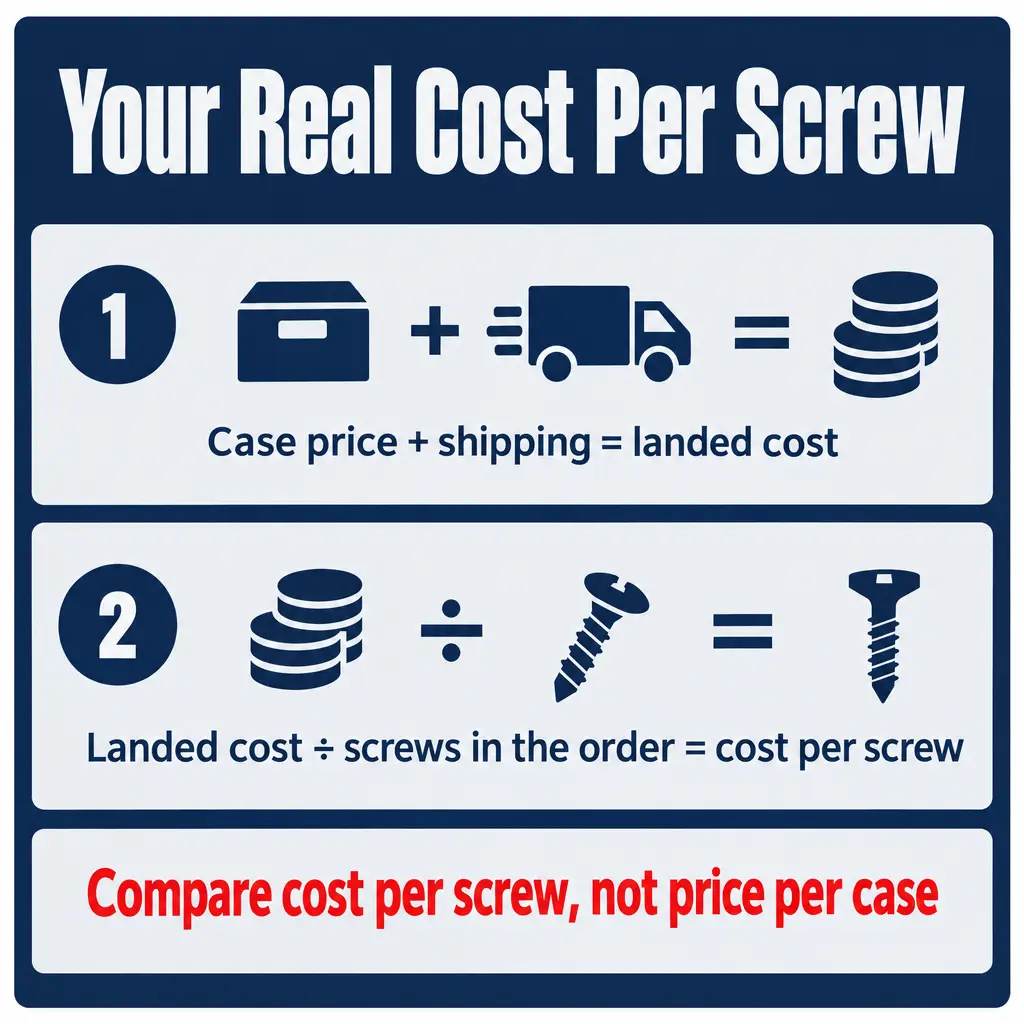
Shipping can add a real amount to a screw order, because full cases are heavy. Ask each supplier for the delivered total on the exact quantity you’re considering, since adding or dropping a case changes the weight being shipped. Our terms are on our shipping policy page.
8. Place the order using the exact part number or specification
Order using the exact part number or specification, so you don’t receive something that is “close” but not actually what you need. A screw that’s close can have the wrong point for the gauge of metal, a head your driver doesn’t fit or a color that doesn’t match the trim, and you won’t find out until the crew opens the case on the job.
Once you’ve settled on a screw, write down the supplier’s part number and use it on every reorder. That’s how you get the same screw every time, even when someone else in your office places the order.
9. Set up a reorder system
Once you know how quickly you go through the product, decide when you’ll reorder so you don’t run out. The simplest way is a reorder point: the number of screws left on the shelf that tells you it’s time to order. To set it, work out how many screws you use while you wait for a new order to arrive, then add a cushion for a busy stretch. That’s the standard method laid out by the Association for Supply Chain Management.
You need two numbers of your own. The first is how many screws you use a day: take your weekly figure from step 2 and divide it by the number of days your crews work in a week. The second is how many days your last few orders took to arrive. If your crews use 100 of a screw a day, every day of waiting takes 100 screws off the shelf. Multiply your daily use by your number of days, add a cushion of a few days’ use, and that total is your reorder point.
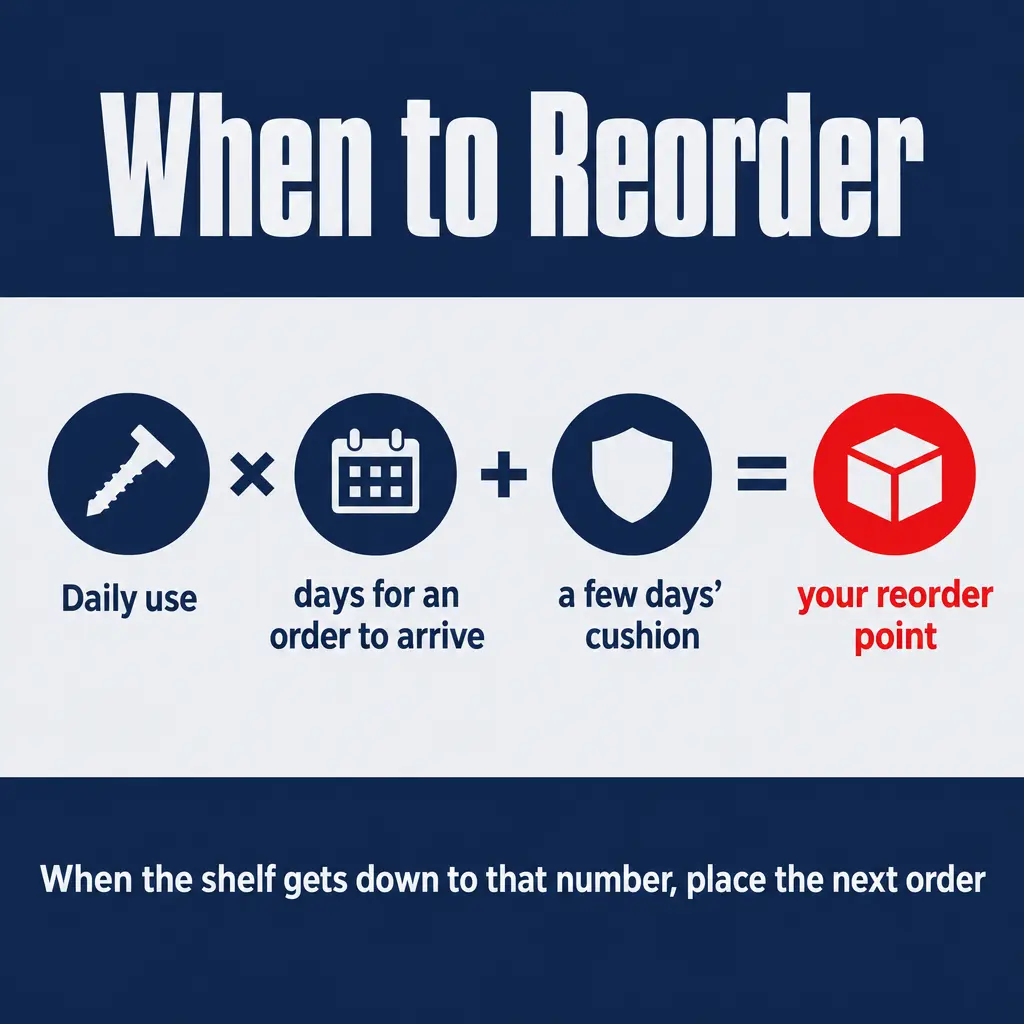
You don’t need software for this. A note on the shelf with the reorder point works. It also helps to write the date on each case when it arrives. When you open the next case, the date on the last one tells you how long it lasted. If you’re going through screws faster or slower than before, raise or lower your reorder point to match. A good supplier sends your parts in a timely manner after you call or email. A great one keeps track of your usage, knows when you should be starting to get low and lets you know to check your stock. That’s how we work at All Points Fasteners.
Why buy from a fastener specialist?
Buying from a fastener specialist saves you time and trouble, because the person you talk to knows the part. The fastener industry is extensive and detailed. There are hundreds of thousands of fastener variations available, each designed to meet different requirements and applications. If the person taking your order hasn’t been properly product trained, or doesn’t know what you’re asking for when your words don’t match the catalog’s, you lose money if you get the wrong part and have to send it back. You also lose time on the job waiting for the right part.
When you call us, a live person who knows fasteners answers the phone. There’s no phone tree, no chatbot and no ticket number. You can describe the job in your own words, and we’ll work out what you mean. We like to say this about our company: “Specializing in breaking down the language barrier between suppliers and end users.”
A specialist also finds what a general store can’t. If you need a specialty size, a part a spec calls for or an unusual material or coating, we’ll do our best to source it for you, though not every part can be found. Quotes come with no obligation, so you can price out a first bulk order before you decide anything. Orders have a $150 minimum.
How do OEMs buy screws in bulk?
OEMs, the manufacturers who build screws into their own products, tend to buy in much larger volume and more consistently. The same nine steps apply, and a few of them carry more weight when the screw goes into every unit that comes off your line.
How often OEMs order depends on how their business is doing. Many of ours order every two months or every quarter, and when business slows down, orders usually slow down too. Most of our OEMs use painted screws, usually custom painted, and custom painting can take 7 to 8 weeks during the busy summer season. That’s why OEMs need a plan for where their business is headed and how many screws they’ll need, so they can order ahead.
- The specification comes first. A screw in a finished product has to match the spec every time. Order by the exact part number or specification, as in step 8, and use it on every reorder.
- Your production numbers shape the quote. Volume affects pricing, so quantity matters to the quote. Bring your real usage numbers from step 2 and ask where the price breaks fall, as in step 4.
- A reorder point protects production. Step 9 matters most when a missing screw holds up a build, not just a job.
What OEMs want most in a supplier is consistent, reliable stock and quality parts delivered on a timely basis.
What first-time bulk buyers get wrong
- Ordering from a supplier who can’t tell what you mean. Head styles go by more than one name. Plenty of people call the drive (where the bit fits) the head, and not everyone has had a reason to learn how screws are measured. A supplier who doesn’t know fasteners ships whatever matches the words, and you find out on the job. Describe the job or send a sample screw to someone who knows fasteners, and let them work out the name and size.
- Ordering “close enough.” You end up with a full case of screws that don’t work for the job.
- Comparing case prices. A cheaper case can cost more per screw once you count what’s in it and add shipping. Quality counts too. Not every company carries quality parts, and not every fastener is made to the same standard. A screw isn’t just a screw.
- Buying part of a case. You pay more per screw than you would for the full case.
- Having no reorder point. The crew runs out in the middle of a job, and someone loses part of the day on a store run.
Ready to buy your first case?
If you’re ready to move from buying by the box to buying by the case, give us a call at 800-483-6354, Monday to Friday, 7:00 AM to 3:00 PM Pacific. Tell us the screw you use and roughly how many you go through, and we’ll quote it. Ask what delivery adds while you’re on the phone. If you’d rather start in writing, you can request a quote or find more ways to reach us on our contact page.